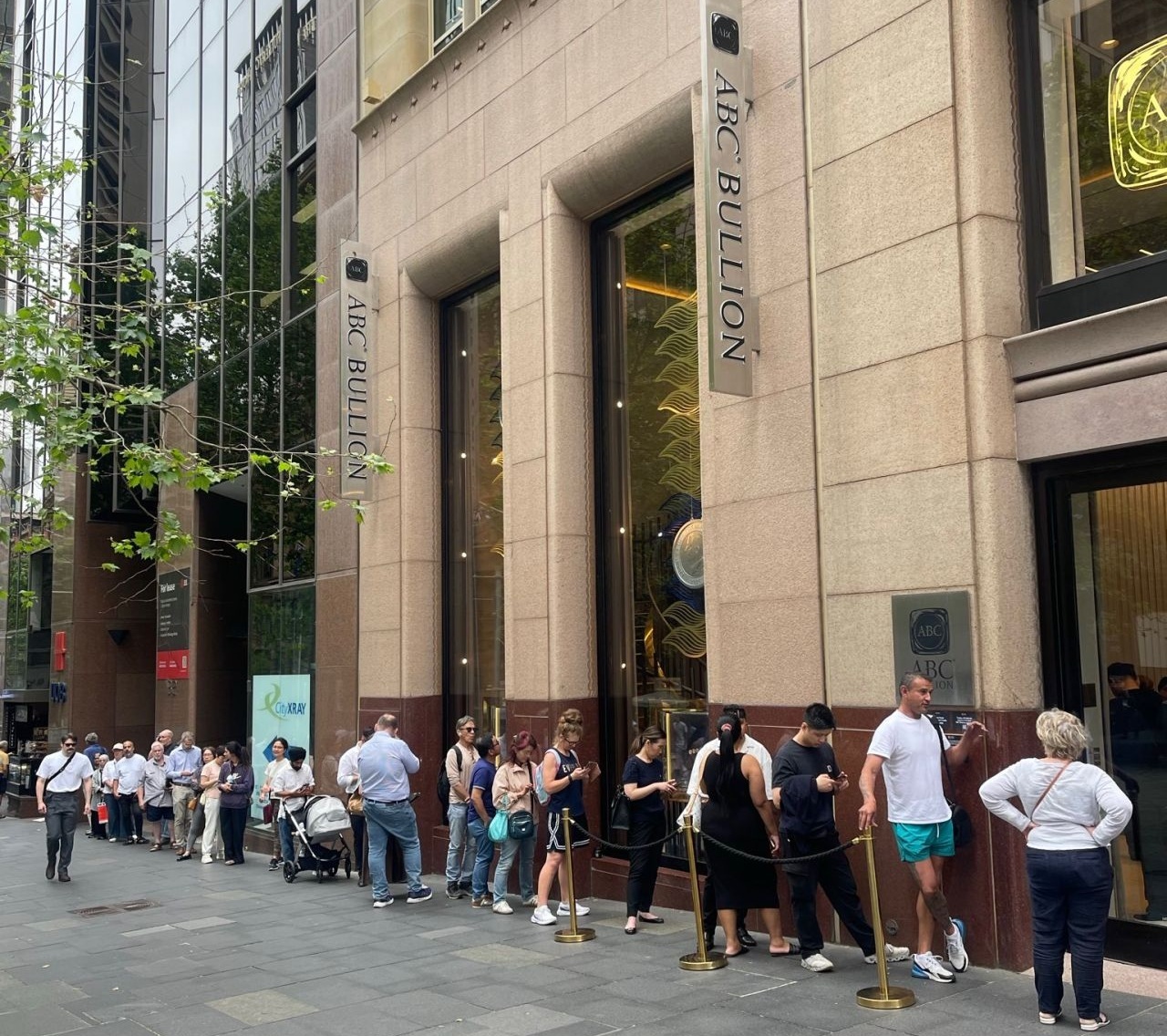
There have been long queues of gold-buyers outside ABC Bullion in Martin Place, Sydney, and World Gold Council’s Shaokai Fan says the appetite of the world’s central banks for the metal also shows no sign of abating despite a 59% price rise in 2025.
“They’ve [banks] been at this buffet table for centuries,” Fan said in a recent interview when asked about national banks returning to the “gold buffet” as bullion’s inexorable price rise has continued. They’d been back “much more often” this year, he said.
“Certainly over the last three years there have been extraordinarily high levels of central bank gold buying,” said WGC’s Asia-Pacific and central banks head, who will speak at IMARC 2025 in Sydney next week on central bank gold demand.
“They bought over 1000 tonnes of gold per year since 2022 whereas the previous average between 2010 and 2020 was less than 500 tonnes.
“So they’re now double the size that they were in the gold market before 2022.”
“I think geopolitical risks are certainly a big part of that ... The different wars that we're unfortunately experiencing [and] instability in terms of trade and policy. Managing all that has become a much bigger job for reserve managers and I think they are turning to gold as a way to mitigate those risks and create more resilience in their portfolio.”
On wider gold demand, Fan says the world’s largest and second-largest gold consuming markets, respectively, China and India, continue to hoard bullion as prices climb.
“Many people focus on gold as a safe-haven asset, as something that performs well during risk-off events, which it does do,” he says.
“But it has a dual nature because almost half of gold demand is still jewellery and industrial demand [which is] the pro-cyclical element.
“In China we’re seeing a lot more retail buying of bars and coins and I think that has to do with specific circumstances in China. The economy has been slowing down, the stock market and housing market have not been performing quite as well. And of course there’s fears of US-China geopolitical confrontations. It’s made a lot of Chinese retail investors buy bars and coins and that’s been the mainstay of consumer buying of gold in China.
“One of the key differences is India has a very, very deep cultural affinity toward gold. A lot of gold jewellery buying is for weddings, for festive occasions [and] for special occasions. People buy gold for those reasons in China as well but I don't think it’s quite as pronounced as it is in India.
“We do see [traditionally] when gold prices are higher the amount of gold jewellery bought is usually softer. But what we’ve noticed recently in India and in many other jewellery markets is the value of the gold jewellery being bought has stayed consistent. The demand for gold jewellery is still there it’s just that with higher gold prices you can't afford to buy as much gold. So we’re seeing are a shift to lower-carat gold [or] smaller pieces, for instance. But this is still anecdotal data for now.
“We’re already seeing some of the early signs of gold demand pick-up for the festive season. The [recent tax reform related] GST cut in India, I think, will put a little bit more tailwind into gold buying despite the higher prices.”
People queue to buy gold in Sydney, Australia.
Asked about next-generation gold buyers, Fan said younger people were seeing more gold headlines.
“They’re getting more used to gold. They’re understanding why it’s important as an asset class,” he said.
“This is a generation that’s facing a very different job market and economic outlook than previous generations, so I think they do have to consider how best to invest their money, to preserve wealth and preserve buying power over the course of their lifetimes and gold is a way to do that.
“In terms of how they’re buying it, we’re seeing a lot of new ways start to emerge.
“Gold ETFs have now been on the scene for over 20 years. They did revolutionise the gold market and are still a very big part of how people invest in gold if they don’t want to buy physical gold, for instance.
“Besides ETFs we’re now seeing tokenised gold start to appear.
“We’re seeing different ways of buying smaller, fractional pieces of gold and in markets like China, where there’s a lot of innovation around finance, we’re seeing smaller amounts of gold being transacted through digital means.
“A lot of the younger investors are attracted to the smaller amounts because they can only invest in smaller amounts, for one, but also the ease and the tech savviness of those channels is better for them.”
The report, produced with London’s The Future Laboratory, seeks to “explore the possibilities of what gold could be used for and how its utility might change in a digital future that is unconstrained by how it is used today”, the WGC says.
“The value of gold as an asset has never been clearer yet the gold industry finds itself at a fascinating crossroads.
“The advent of new technologies, including blockchain, decentralised finance and cryptocurrency is having a transformational effect on the financial markets that gold operates in. A new age of easily accessible, yield-bearing digital assets puts traditional assets under the spotlight, potentially disrupting their financial status. But at the same time these innovations create previously unimaginable opportunities for gold to thrive as the ultimate physical and digital asset.
“The results could be game-changing for the gold industry, increasing trust in gold markets, and recreating the metal as a fungible and highly liquid digital asset capable of powering the financial markets of the future.”
Commodities
Investment and Finance
Geopolitics
International Mining and Resources Conference + EXPO
Meetings run for 48 hours, so every participant gets two full business days in their own time zone. All meeting times show in your local time on the platform.
It looks like you're trying to log in with an email address that isn't registered with our system. Registering is both quick and easy! Just click the button below to sign up.
NOTE: If you're trying to access presentations or content associated with your exhibition attentance please sign up with the email address used for the exhibition participation.
Generating download...
Submitting...
It looks like you're opted-out for emails
The email address you have entered has opted-out of email communications from us.
You will need to opt back in to receive a response from this form submission.
PLEASE NOTE: This action will only opt you back into the email communications you specify when you manage your email preferences. You will be able to choose the type and frequency of communications you receive from us.
If you would prefer not to opt back in please contact us directly via email or phone.
Share
Copied to clipboard
Accessibility options
Font size
Contrast
Beacon is committed to providing a digital experience that is accessible to all users, including people with disabilities.
As such, we are continually working to improve the accessibility of our website by adhering to the Web Content Accessibility Guidelines (WCAG).
Some content on our website may not be fully accessible. We are working to address these issues.
If you experience any accessibility issues with our website, please contact us at [email protected]